
What does this mean for carriers and what do we recommend?
2026 begins with important changes for the transportation industry in Mexico.
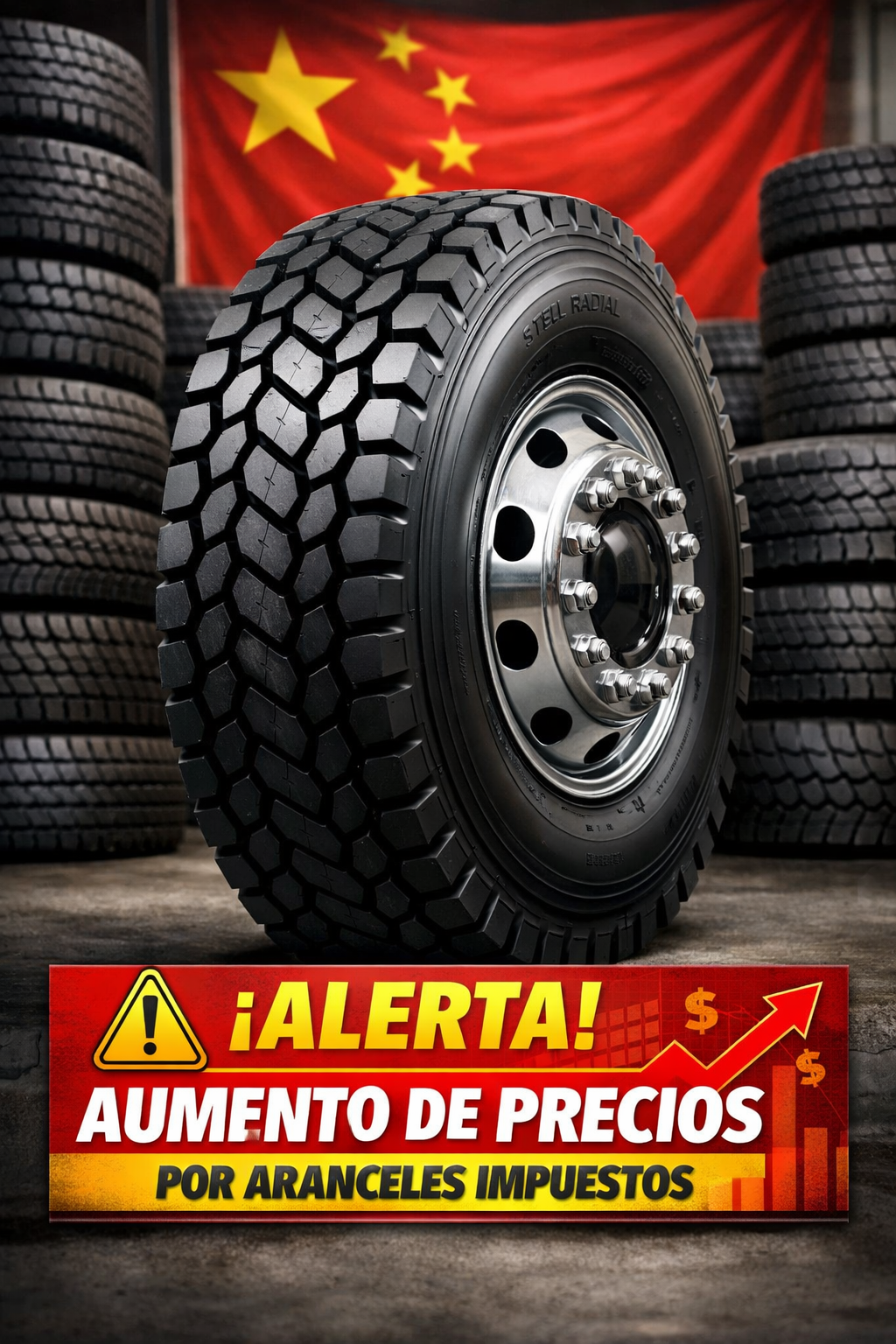
Uno de los más relevantes —y que ya está generando ruido en el mercado— es el aumento de hasta 25% en los aranceles a llantas asiáticas, particularmente a las llantas de origen chino.
Este cambio no es menor: las llantas chinas representan más del 80% del mercado de reemplazo en México, por lo que el impacto será directo y tangible para la mayoría de las flotas y hombres-camión.
En este artículo te explicamos qué implica realmente este aumento, cómo podría comportarse el mercado y qué recomendamos hacer como transportista para proteger tu operación.
What's happening with tariffs in 2026?
A partir del 1 de enero de 2026, entraron en vigor nuevos aranceles a diversas fracciones arancelarias, incluyendo llantas provenientes de países asiáticos sin tratado comercial preferencial con México.
In simple terms:
- Muchas llantas económicas importadas desde Asia tendrán un incremento aproximado del 25% en su costo de importación.
- Ese aumento termina reflejándose directamente en el precio final al transportista.
- The impact is greater on brands whose main differentiator was the low price.
Why does this affect carriers so much?
Tires are not a minor expense within the operation.
In fact:
- Las llantas son el segundo insumo más importante de una flota, solo por debajo del diésel.
- Cualquier variación en su precio impacta directamente el costo por kilómetro.
- Muchas empresas presupuestaron 2026 con precios de llantas similares a 2024–2025, lo cual hoy ya no es realista.
Para esas flotas, el golpe no es solo el aumento del precio unitario, sino el desbalance completo del presupuesto operativo.
How do we think the market will behave?
From Quinta we see several likely scenarios:
1. Heavy pressure on budget tires
The cheapest tires lose much of their advantage.
El diferencial de precio contra llantas de gama media se reduce drásticamente.
2. Increased interest in higher quality brands
Many tires that previously “looked expensive”:
- Now they are much closer in price.
- They offer better performance, less irregular wear and a longer lifespan.
3. Greater sensitivity to cost per kilometer
It will no longer be enough to simply ask:
“Which one is the cheapest?”
The correct question will be:
“Which one costs me less per kilometer traveled?”
Higher quality tires as a more viable option
With this new scenario:
- An inexpensive tire with low performance ceases to be so attractive.
- Una llanta de gama media (e incluso algunas premium bien administradas) empiezan a ser financieramente más lógicas.
When you compare:
- Starting price
- Actual lifespan
- Renewability
Muchas llantas “más caras” terminan siendo más baratas a lo largo de su vida.
Recommendations if you are a transporter
At Quinta, we work every day with real tire performance data, not assumptions. Based on that, here are our recommendations:
1. Find your tire suppliers as soon as possible
Esta recomendación es clave en este momento del año.
Around this time:
- Inventory yourself today.
- Para que cuando los precios suban formalmente, no lo sufras de inmediato en tu operación.
2. Stop buying tires based solely on price.
Después de la seguridad, el costo por kilómetro debe ser el principal criterio de compra.
Explore:
- Brands you previously dismissed because of price.
- Options with proven better performance.
- Tires that you can control and measure, not just buy.
3. Before thinking about changing tires, think about taking better care of them.
This is the most important part.
If you succeed:
- Extend tire life by 30–40%,
Your investment is much better protected, even with higher prices.
Small actions generate big results:
- Tracking by tattoo or identification.
- Constant pressure monitoring.
- Periodic depth measurement.
4. Use technology to make tires last longer (and fail less)
Today there are accessible tools that make a huge difference:
- Bluetooth depth gauges.
- Intelligence platforms for tires.
- Real-time pressure and temperature sensors.
This allows:
- Reduce blown-out tires.
- Detect problems before they turn into roadside stops.
- Take care of the tire without adding more work to the staff.
When things get tough, technology stops being an expense.
“I don’t want to spend any more.”
But the reality is different.
Measure in real time:
- Pressure
- Temperature
- Burden
- Depth
Not only does it help you get the most out of each tire, it also:
- Reduces roadside stops by up to 80%.
- Save fuel.
- It reduces corrective maintenance.
- It helps prevent theft and bad practices.
Conclusion
Tariffs and uncertainty make the outlook complicated, there's no doubt about it.
But they also open up a clear opportunity:
If supplies are going to be more expensive, now is the best time to take better care of them and make data-driven decisions.
At Quinta we believe that:
- The future of transport is not about buying cheaper.
- Está en administrar mejor, medir mejor y decidir mejor.
Visit www.quinta.tech and learn how to save on tires with AI technology
 English
  Spanish