
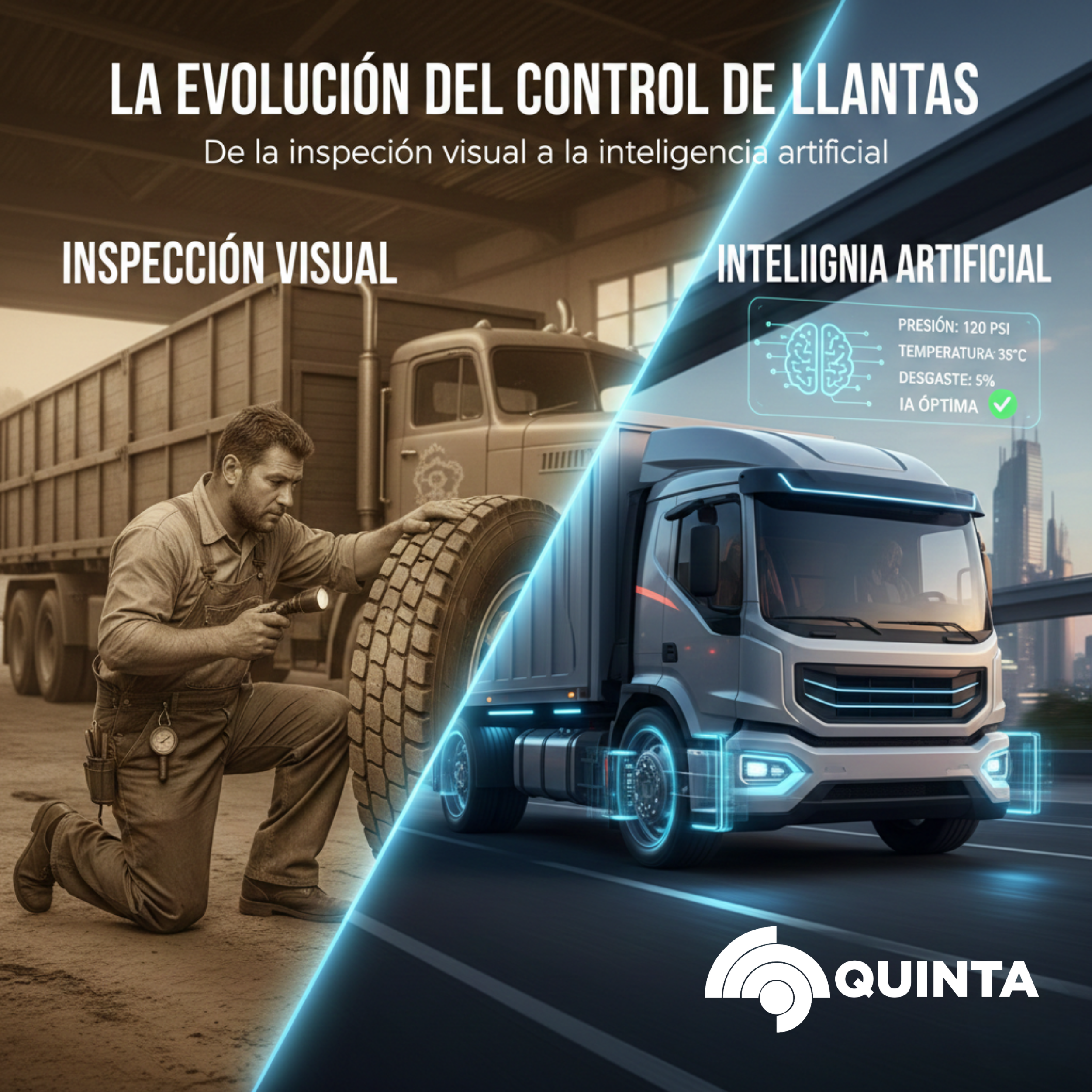
In freight transport, few things seem as simple—and yet as critical—as a tire. For decades, it was seen merely as another input: purchased, mounted, used, and replaced when it failed. However, over time, tires have become one of the most decisive factors in the operating costs, safety, and efficiency of a fleet.
This is the historical journey of tire control in freight transport, from its most rudimentary beginnings to the current evolution with intelligent sensors and artificial intelligence, such as those being developed today by Quinta.
The beginnings: visual inspection and operator experience
For much of the 20th century, tire control relied almost exclusively on human expertise. Operators and maintenance personnel performed visual inspections before and after trips.
- Visible bumps or deformations
- Uneven wear on the tread
- Manual pressure check (when it was done)
Manual pressure check (when it was done) “That tire already looks tired”, “That pressure can’t handle the route”Although this method worked for years, it had a major weakness: human error and a lack of objective data.
The faults were usually detected when it was already too late, causing flat tires, blowouts, delays, accidents and unexpected costs.
Standardizing maintenance: pressure, mileage, and logbooks
With the growth of fleets and the professionalization of transportation, the need arose to standardize processes. The first formal tire control practices appeared:
- Recommended pressure tables according to load
- Mileage-based rotation programs
- Physical maintenance logs
This was a significant advance: for the first time, an attempt was made to anticipate wear and tear, not just react to failure. However, the system remained reactive and static.
This was a significant advance: for the first time, an attempt was made to anticipate wear and tear, not just react to failure. However, the system remained reactive and static.
- Actual route type
- Actual route type
- Intermittent overload
- Condiciones climáticas
The hidden cost of tires: when the problem stopped being just technical
As transportation margins became tighter, companies began to notice something key: tires don't just fail, they silently drain money.
- Incorrect pressure = higher fuel consumption
- Irregular wear = shorter life
- Unforeseen failures = downtime and penalties
That's when tires went from being a mechanical issue to becoming a financial and strategic one.
- It showed the problem, but it didn't explain why.
- I didn't connect the tire with the actual operation.
- It generated data, but not knowledge
The information remained isolated, without context or in-depth analysis.
From data to decisions: the evolution towards intelligent analytics
Con la expansión del IoT, la telemetría y el análisis de datos, el enfoque cambió radicalmente. El objetivo dejó de ser solo measure the tireand became to understand its behavior in the actual operation.
This raises a new question:
Why do two identical tires in the same fleet have completely different performances?
The answer lay in the data that was previously hidden:
- Route type
- Actual load
- Actual load
- Brakes
- Operating temperature
The present: sensors with artificial intelligence and predictive control
Today, tire management has entered a new era. With solutions like Quinta's, tires are no longer a passive component but an active source of strategic information.
The smart sensors integrated into the tires allow:
- Continuous monitoring of critical variables
- Analysis of actual performance on each route
- Early detection of wear patterns
- Recommendations based on real data, not assumptions
Artificial intelligence transforms thousands of data points daily into clear decisions:
- Qué llanta funciona mejor para cada operación
- When to intervene before a failure
- How to optimize the cost per kilometer traveled
How to optimize the cost per kilometer traveled
The biggest change is not technological, it is conceptual.
Before:
- The tire was changed when it failed.
- The cost is assumed to be unavoidable.
Now:
- Failures are anticipated
- The useful life is optimized.
- The entire operation is protected.
The tire ceases to be an expense and becomes a measurable and optimizable asset.
The future of transport is built from the ground up
In a sector where every kilometer counts, intelligent tire management is no longer a luxury, it's a competitive advantage.
The evolution is clear:
- From intuition to data
- From data to analysis
- From analysis to artificial intelligence
And along the way, fleets that adopt advanced technologies will not only reduce costs, but will operate with greater safety, efficiency and profitability.
Because in freight transport, the future doesn't start with the engine... it starts with the tires.
Today it's no longer just about buying cheaper or better brand tires, but about making decisions based on real data from your operation.
If you want to know which tire gives you the best performance on your routes, when to intervene before a failure, and how to reduce your cost per kilometer, it's time to take the next step.
Schedule a demonstration with Quinta and turn your tires into a competitive advantage for your fleet.
The information is already out there. The difference lies in knowing how to read it.
 English
  Spanish