
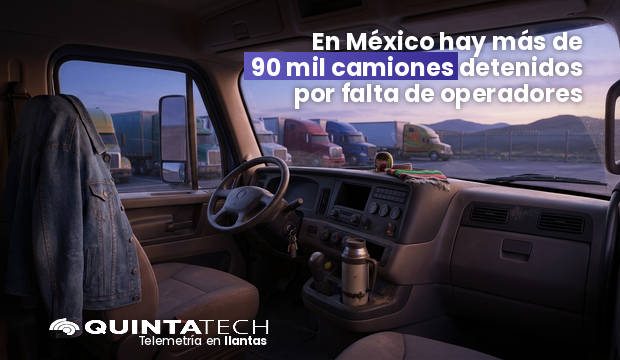
In Mexico, more than 90,000 trucks are sitting idle. It’s not due to a lack of cargo or a mechanical failure: there is no one to drive them.
This figure was provided by Augusto Ramos Melo upon assuming the presidency of Canacar in February 2026. Behind every idle vehicle lies an unfulfilled contract, a cancelled route, and a company losing revenue while continuing to pay for the asset. The trucking industry moves 81% of the country’s land-based freight. When there is a shortage of personnel, everything else grinds to a halt.
The figures that no one wants to see
According to Canacar, there is currently a shortage of 96,000 operators in Mexico. And the gap is not closing—it is widening.
- Between April 2025 and April 2026, 20,000 operators lost their work visas because they failed to demonstrate proficiency in English. These are drivers with years of experience on cross-border routes who left the system within a twelve-month period.
- Nearly 15,000 operators will retire over the next three years. There are not enough replacements to fill their spots.
- The reform to reduce the workweek to 40 hours could worsen the deficit, according to an analysis by Kearney regarding land transport in Mexico.
- The problem is global: by 2030, the worldwide shortage could exceed 2.8 million drivers.
Canacar set a goal to add 5,000 new operators during its tenure. It is a necessary effort, but it highlights the scale of the challenge: it amounts to covering just over a third of the projected retirements.
Why no one wants to get into the cab
The deficit is not just a matter of salaries. It is the result of a profession that is demanding, risky, and lacks proper recognition.
The road is frightening. In Mexico, a cargo truck robbery occurs approximately every 50 minutes, and Canacar acknowledges that the vast majority are committed with violence. For the driver, every unplanned stop is an exposure.
Rest comes only in snatches. An initiative presented to the Chamber of Deputies in February 2026 describes long work shifts with fragmented rest periods—taken wherever possible, rather than where it might be appropriate. This is where roadside truck stops and unregulated parking areas come into play, remaining a fixture of daily operations.
On the other side of the border, the pay is higher. Canacar has warned that U.S. companies are offering salaries up to 200% greater, in an environment with less insecurity.
There is a lack of training. According to the IRU, 66% of Mexican operators believe that the primary cause of the shortage is a lack of training.
What it costs your fleet
When an operator leaves, it’s not just another vacancy. It’s a loss of capability that disappears overnight.
The vehicle continues to incur costs (insurance, financing, maintenance, parking), yet it no longer generates revenue. Customers who rely on timely deliveries begin to look for alternatives. Furthermore, replacing an experienced operator takes time: recruiting, training, and entrusting someone with a route cannot be accomplished in a single week.
There is also a cost that does not appear on the income statement: the knowledge that leaves with the individual. Someone who has spent years on a particular route knows where to stop, which stretches to avoid at night, and how their vehicle behaves. That cannot be replaced simply by hiring someone new.
Taking care of the operator is also taking care of the unit
Think of a common scenario: eleven o’clock at night, a deserted stretch of road, a tire blows out. The driver has to stop wherever they happen to be, get out, inspect the damage, and wait. Every minute spent there is a minute spent exposed.
Many of those stops could have been foreseen. A tire almost never fails suddenly; instead, it gradually loses pressure, heats up more than usual, or wears down unevenly. The problem is that no one notices this in time, because checking every single tire at each stop is precisely the kind of task that gets skipped when an operator is tired and in a hurry.
That is why, at Quinta, we view tire monitoring as a way to lighten the operator’s burden, not as a means of surveillance. By tracking the pressure, temperature, and wear of each tire in real time, alerts are received before a failure occurs. This allows for stops to be planned in a safe location, rather than having to improvise on the side of the road.
Technology will not solve the shortage of operators. But it can make the work of those who remain safer and less physically demanding. Today, that, too, is a way of retaining them.
What you can do starting today
- Ask them. Talk to your operators about what drains the most of their energy while on the road. The answers tend to be specific and inexpensive to address.
- Plan your stops. Identify safe locations for rest and refueling, and avoid relying on improvisation along your route.
- Invest in training. If a lack of training is the number one reason—according to the operators themselves—then that is the most direct lever for improvement.
- It opens the door to new types of profiles. Canacar considers the participation of women to be essential for achieving a generational shift.
- Remove manual tasks from them. Anything that technology can monitor on their behalf—such as tires, routes, or alerts—frees up the operator to focus on driving safely.
The wheels do not turn on their own.
We can have the best trucks, the best routes, and the best clients. Without someone behind the wheel, none of it moves.
The shortage of operators will not be resolved this year or next. But every fleet can decide, starting today, how it treats those who are still behind the wheel. Looking after them is no longer just the right thing to do—it is a prerequisite for continued operation.
This is the same technology with which Quinta Tech won the KPMG Private Enterprise Global Tech Innovator México 2026. And we created it with those who are on the road every day in mind.
Do you want your operators to drive more safely? Learn how real-time tire monitoring works:
- WhatsApp: 446 265 4870
- Website: www.quinta.tech
Sources
- Milenio: 20,000 Mexican truck drivers lost their visas, Canacar
- El Financiero: Augusto Ramos Melo assumes the presidency of Canacar for 2026–2027
- The Logistics World: Vulnerabilities in freight transportation in Mexico (Kearney)
- The Logistics World: Truck drivers migrate to the United States
- The Logistics World: IRU on operator training
- The Logistics World: Cargo Theft on the Road to the 2026 World Cup
- Total Protect: 2026 World Cup and logistical risks (Canacar figures)
- Parliamentary Gazette, February 10, 2026: initiative regarding motor transport operators
- C.H. Robinson: Cross-border update, August 2026
 English
 Spanish